
Coexistence Guide
This time, maybe you don't have to say goodbye to your cat just yet.
A Practical, Science-Based Guide to Coexisting with Cats for Families Managing Cat Allergies
OKCLEAR · 2026.10.16 · ~10 min read
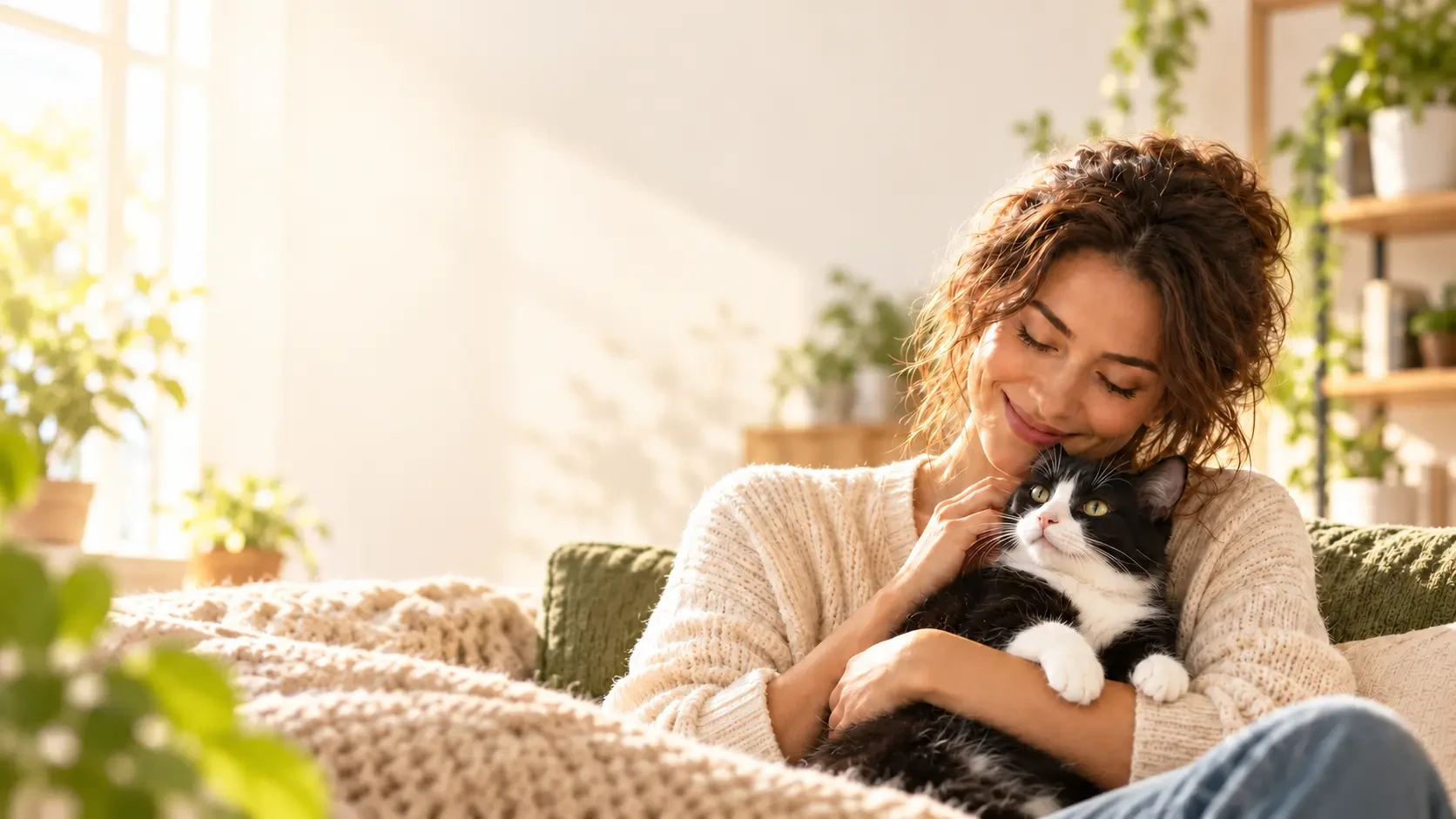
This message offers hope but makes no guarantees: before deciding to rehome your cat, many families can explore safer, evidence-based solutions first.
Assess risks first, then say goodbye properly.
Allergies can turn a simple hug into an unsettling dilemma: must we give up our cat? Often, the better first step isn't a hasty goodbye, but a thoughtful plan that protects your health while respecting the animal that depends on you.
The common thread behind many help requests
A mother noticed her young child breathing comfortably outdoors but struggling to breathe inside their one-room apartment. A person who has lived with a cat for years suddenly began sneezing, tearing up, and experiencing nasal congestion. Another cat owner faced severe symptoms alongside the stress of moving, leading them to believe that finding a new home for their beloved cat might be the only responsible choice.
These scenarios synthesize recurring themes from public discussions and do not directly reference any specific individual's experience. They all point to the same painful conflict: human health versus the emotional bond between people and their companion animals.
Every family's situation is unique. While severe asthma or breathing difficulties may sometimes necessitate temporary separation or relocation, many families should first identify the true triggers, reduce exposure, and evaluate a tiered approach to make daily life safer before making that decision.
Cat allergies: The real culprit isn't cat hair.
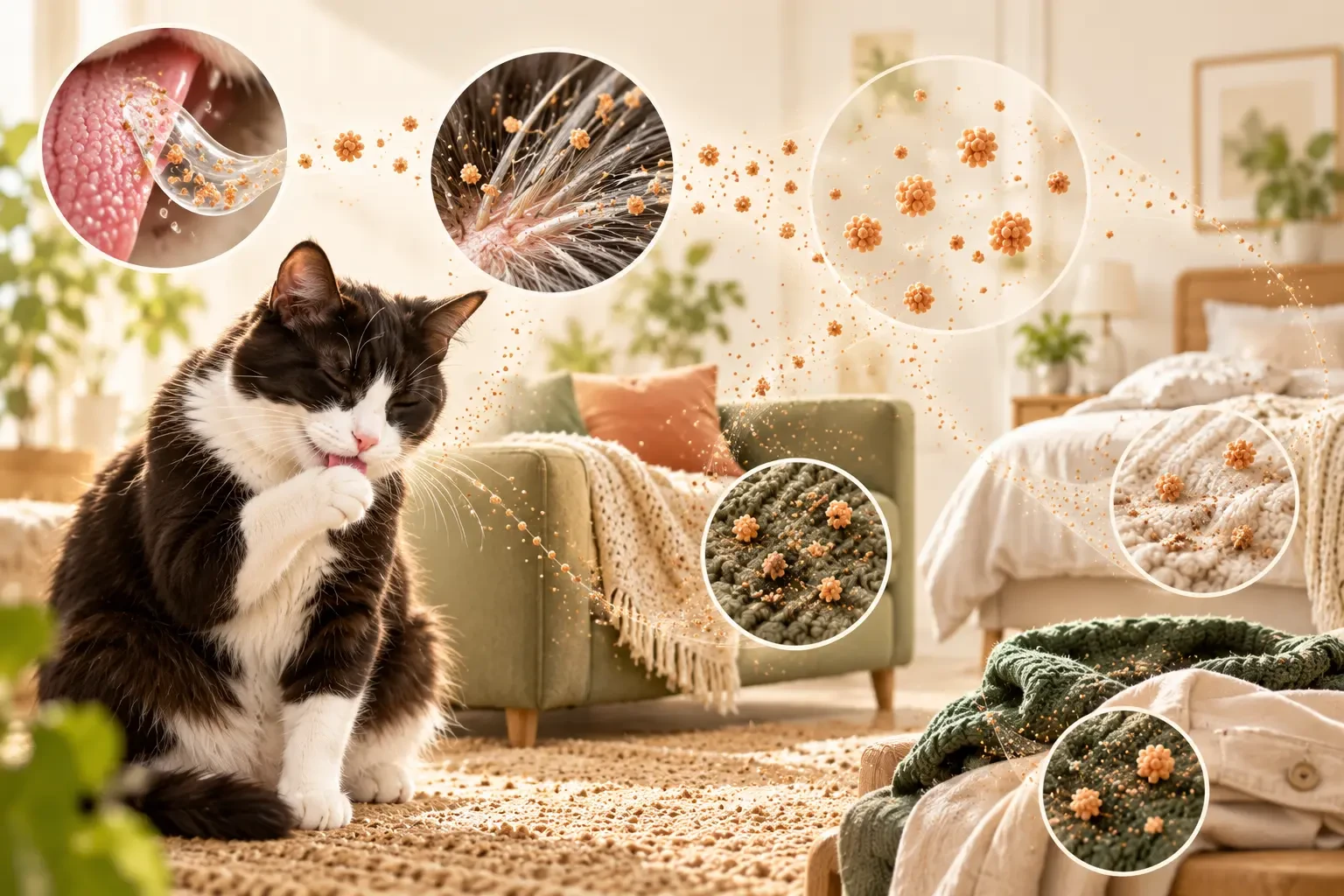
Cat allergy is a reaction to certain proteins, not the fur itself. The most well-known is Fel d 1, which is primarily found in cat saliva and skin secretions. When cats groom themselves, saliva coats their fur; once these particles dry, they can become airborne and settle on sofas, bedding, carpets, and clothing. Exposure can persist even when the cat is not in the room.[1][4]
Trimming a cat's fur or styling it in the so-called "teddy bear cut" is not a reliable allergy management solution. While it may reduce some loose hair, it cannot prevent cats from producing Fel d 1. Any decision to alter your cat's coat or grooming routine should prioritize skin health, thermoregulation, and stress reduction, and must be discussed with a veterinarian beforehand.
Why do symptoms appear to come on suddenly?
Cat allergies don't always trigger an immediate reaction. According to the AAAAI, prolonged exposure can lead to chronic symptoms like persistent nasal congestion. Dust mites, mold, smoke, and other indoor allergens may also cause or worsen similar issues. The timing of symptoms alone cannot identify the trigger; an allergy specialist can evaluate patterns and recommend testing if needed.[1]
Security always comes first, ahead of any product.
Difficulty breathing should not be managed by trial and error at home.
Severe difficulty breathing is a medical emergency. In children, warning signs include labored breathing with chest retractions, inability to speak or cry normally, abnormally rapid breathing, and blue or gray lips/face. Adults experiencing severe breathing trouble, rapidly worsening throat swelling, blue or gray lips, or confusion require immediate emergency care. Follow local emergency medical guidelines. Consult a qualified physician or allergist for persistent sneezing, itchy eyes, nasal congestion, coughing, or suspected asthma.[3][6]
A sustainable, tiered home organization system
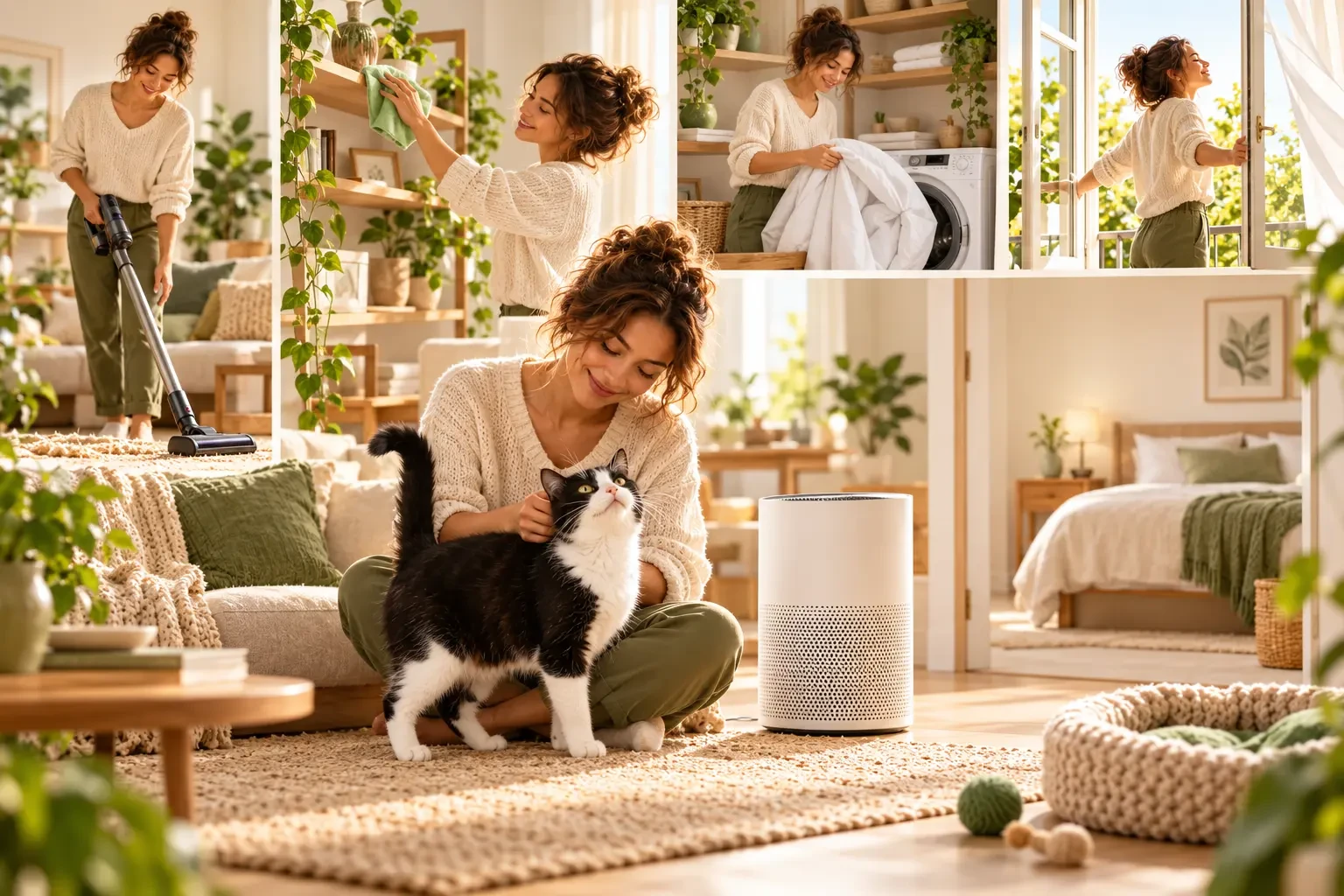
No single measure eliminates all allergens. A more realistic approach is to reduce exposure at multiple points—sources, air, and surfaces—and then monitor for actual changes. Start with strategies your household can sustain long-term.[2]
Protect your sleep space first
Keep cats out of allergy sufferers' bedrooms, keep doors closed, wash bedding regularly, and avoid bringing cat hair or allergens onto the bed.
Filter for rooms you truly live in long-term
Choose an air purifier with a CADR for particulates that matches your room or open space. HEPA filters are common, but proper room sizing, good airflow, sufficient run time, and regular filter replacement are equally important; avoid devices designed to intentionally generate ozone.
Manage particles deposited on the surface
Use a vacuum cleaner with a HEPA filter and damp-mop instead of dry dusting. Regularly wash blankets and upholstered furniture, and consider reducing items that easily collect dust.
Improve the complete indoor environment
Ventilate when outdoor air conditions allow, and check for dampness, mold, smoke, scented products, and other irritants. Air filtration supplements source control and ventilation but cannot replace them.
Track patterns, don't rely on memory.
Track symptoms, room conditions, activities, and environmental changes for 2–4 weeks. When possible, change only one major variable at a time to make discussions with your doctor more productive.
A more actionable approach involves multi-layered coordination: professional medical guidance, source control, ventilation, air filtration, and a sustainable cleaning routine. IgY targeting specific allergens can be combined with Fel d 1, but it does not treat or reprogram the human immune system.
The role of IgY in this scientific pathway
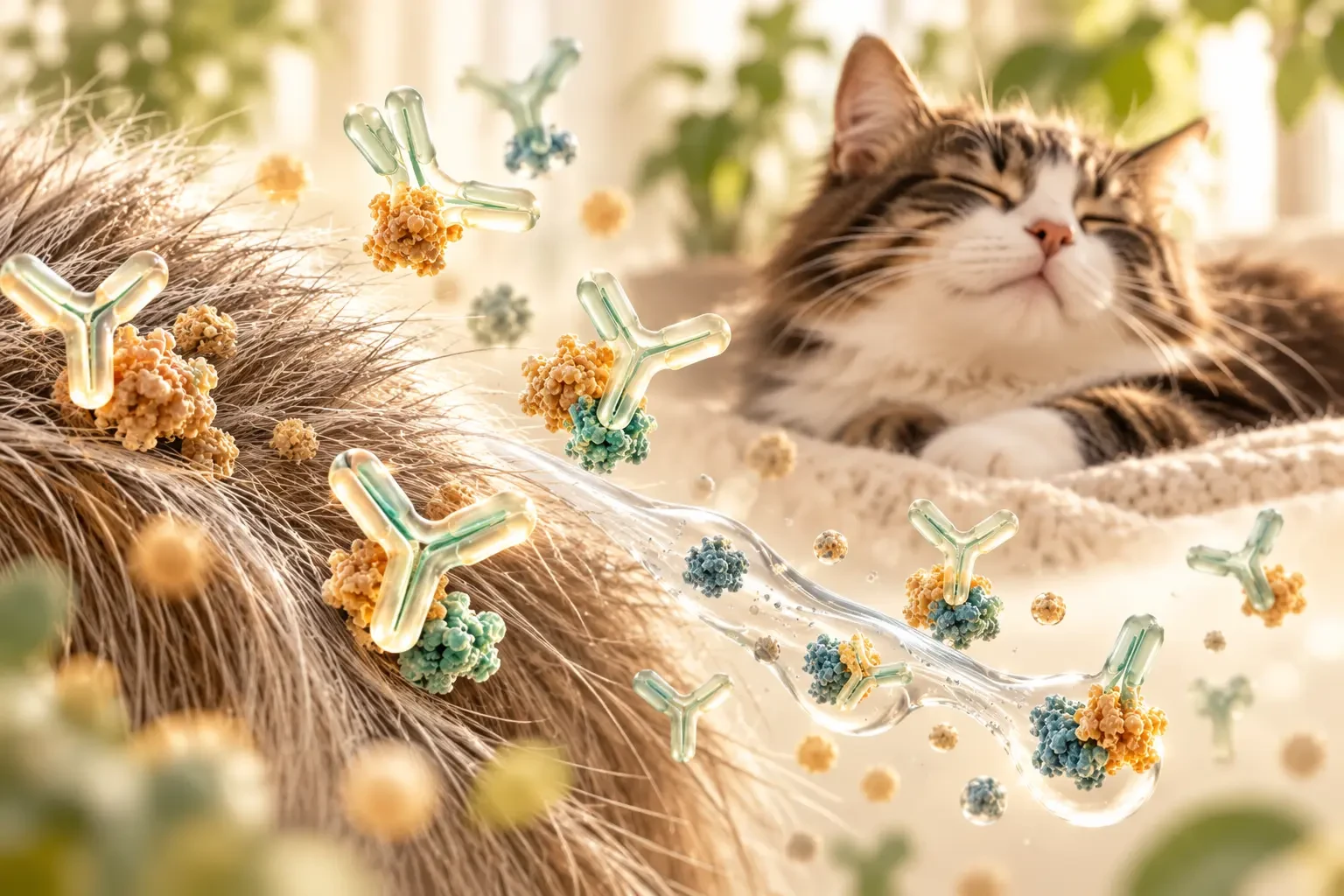
IgY is an antibody derived from egg yolks that targets specific allergens. In a controlled feeding study funded by Nestlé Purina, food containing approximately 8 ppm of anti-Fel d 1 IgY significantly reduced immunoreactive Fel d 1 in cat saliva starting at week 3. In another crossover study involving 105 cats, significant reductions in coat-bound active Fel d 1 were observed starting at week 3, with an average decrease of 47% by week 10.[4][5]
Neither study was a human clinical trial involving allergic individuals, and both evaluated specific Purina formulas. The fur study lacked a concurrent control group. These findings support the mechanism of action of anti-Fel d 1 IgY but do not directly validate OKCLEAR, prove equivalence across all IgY products, confirm that cats will become "allergen-free," or guarantee symptom improvement for every allergic person.
What OKCLEAR is, and what it isn't.
OKCLEAR is an IgY-based cat allergen source management solution currently under development, not a human medication. The publicly available research cited above supports the general mechanism of anti-Fel d 1 IgY but does not constitute direct validation of OKCLEAR's product performance. Any claims regarding OKCLEAR's ability to reduce Fel d 1 or other cat allergens must be supported by OKCLEAR's own validated test data, testing conditions, and applicable market regulations.
- OKCLEAR is a component of a comprehensive allergen-reduction strategy, not a cure or treatment for human allergies.
- OKCLEAR is a non-pharmaceutical approach based on IgY and is not a substitute for allergy specialists or prescription medications.
- OKCLEAR is a source management tool used according to product instructions and does not guarantee that human symptoms will disappear.
- Evaluation of OKCLEAR should be based on product evidence; it does not prove that the cat is "hypoallergenic" or completely free of allergens.
For distributors, retailers, and professionals, responsible evaluation should address four key questions: Which product claims are supported by internal data? What usage conditions were applied during testing? What quality control measures are in place? And which claims are legally permitted in the target market? Evidence and claims must always align.
Create a careful plan before finding your cat a new home.
A compassionate approach protects both people and cats. If there is no immediate medical emergency, follow these steps in order with the help of a qualified professional.
- Confirm potential causes:Don't assume all indoor symptoms are caused by your cat; consult a doctor for allergy testing and other environmental triggers.
- Set security boundaries:Clarify with your doctor which symptoms require stopping home care immediately and when to seek emergency medical attention.
- Create Protected Room:Designate the allergic person's sleeping area as the home's cleanest, most cat-free zone with consistent protocols.
- Implement multi-layered measures continuously:Combines source control, HEPA filtration matched to room size, cleaning, ventilation, and doctor-recommended treatment.
- Honest Product Assessment:Follow the instructions carefully and rely on evidence from this specific product rather than broad conclusions drawn from other formulations.
- Reassess, don't guess:Review the records with your doctor after the agreed-upon interval to determine if the plan is safe enough to continue.
Sometimes, even when a family has made sincere efforts, temporary foster care or responsibly rehoming a cat may be the safest choice—especially if asthma is uncontrolled or a child is experiencing breathing difficulties. This does not mean there isn't enough love. If separation becomes necessary, please place your cat through a trusted rescue organization, foster network, or carefully screened adopter. Never release an indoor cat to the outdoors.
Don't make goodbye the first step.
This article does not make medical promises; it aims to help families evaluate more options. With a confirmed diagnosis, treatment guided by a physician when needed, and consistent implementation of exposure-reduction measures, some families may be able to continue living with their cats. This outcome cannot be assumed or predicted for everyone, especially in cases of uncontrolled asthma.
Before saying goodbye, let's ask one more question: Have we tried all safe, reasonable, and evidence-based options with professional support?
Join us to make this choice more accessible.
OKCLEAR is seeking distributors, importers, pet retailers, and e-commerce partners who value scientific evidence and user experience. We welcome discussions on local compliance, product evaluation, and market education.
info@okclearpet.com · Learn about products like Cat Dander Relief Powder · Partnership Inquiry
References
The following resources support the general medical, indoor air management, and IgY scientific context discussed herein. All product-specific claims regarding OKCLEAR must be based on OKCLEAR's own validated evidence and applicable regulations in target markets.
- Pet Allergy — American Academy of Allergy, Asthma & Immunology
- Home Air Cleaners Guide — U.S. Environmental Protection Agency
- Breathing Trouble Symptom Checker — HealthyChildren.org, American Academy of Pediatrics
- Satyaraj E, Li Q, Sun P, Sherrill S. An egg ingredient containing anti-Fel d 1 IgY reduces allergen levels in cat saliva. J Feline Med Surg. 2019.(Author disclosures: The author is employed by Nestlé Purina. This study does not directly validate OKCLEAR nor demonstrate improvement in human symptoms.)
- Satyaraj E, Gardner C, Filipi I, Cramer K, Sherrill S. Reduction of active Fel d 1 from cats using an anti-Fel d 1 egg IgY antibody. Immun Inflamm Dis. 2019.
- Allergies: Emergency Symptoms and When to Seek Help — NHS
Important Medical Notice:This content is for general health and scientific education only. It does not constitute medical advice, diagnosis, or treatment, nor does it indicate that OKCLEAR is suitable for any specific individual. If you have concerns about allergies or asthma, please consult a qualified healthcare professional. Seek immediate professional evaluation if you experience difficulty breathing, blue lips or face, severe wheezing, or rapidly worsening throat symptoms.
Read more
Living Guide: From Household Pain Points to Sustainable Management Paths
Research White Paper: From Fel d 1–8 to Shared Environments →

IMPORTANT
This content is for general health and scientific education only and does not constitute medical advice, diagnosis, or treatment. If you have concerns about allergies or asthma, please consult a qualified healthcare professional.
OKCLEAR
Need product documentation or proof?
This will open your default email client. We will prepare the relevant materials based on the project scope.